Sunday, August 7, 2011

Enjoy Your Wine More! -- Wine Glasses 101

Many articles are written about how to choose a wine.  The current guideline from the people who do such things is, thankfully, much more flexible and wine-drinker friendly.  

 As a painter, customers frequently ask me which glass, design, and/or which color would be "best".  In this post, I share some designs along with glass types and shapes as an introduction to future posts about the wonderful myriad of stemware choices.

Red wine, white wine and sherry and port glasses

First, let me explain that designs can be painted on nearly any glass with a smooth surface.  Prices may reflect the material -- crystal or glass-- and quality of the material as well as the painting time involved. 

Happily there are now options for many price ranges, plus non-lead crystal and dishwasher-safe crystal.   

Painting on crystal is like skiing on the lightest powder – a silky, lustrous texture in the hand.  Crystal also yields a slightly different translucency to the paint, allowing more subtlety to the finished result.  There are now so many affordable price options for crystal that it is becoming ever more popular.  Most Etsy sellers are willing to accommodate special requests, so inquire if you have a preference.

However, the paint may not be dishwasher-safe and may flake or fade.  Some glasses or crystal (according to a manufacturer’s rep) expand under extreme heat in a dishwasher; the paint may not expand and may crack.  When shopping for glasses online, read the seller’s satisfaction guarantee and return policy. 

Of course, the design options are limitless, and I really enjoy creating new designs.  Customers frequently request new combinations and designs.  Based on info from my customer and her objective, I usually email swatches of colors and photos of a prototype before beginning to paint.  When finished, I send photos of the completed stemware.  Paint is a wonderful medium to get things just as you want them!
  
I’m big on multi-tasking and I bet you are, too, so when looking for stemware, imagine it holding a rich chocolate mousse or fresh fruit.  Of course, it works for martinis and margaritas, too!

Next is which style of glass to choose.

Here are several styles of wine glasses, using the same basic design theme, and you can see the thin crystal glasses on the left (with lighter designs) and glass-glasses on the right with thicker stems and rims.  

 
If you’ve ever wondered why there are different shapes for different wines, below is a basic primer.  Until the mid-50’s, wine glasses had the same general shape.  Beautiful glasses and very elegant!


Vintage Crystal Wine Glass from VintageBiffAnn
However, taste testing in the 1950’s determined that the shape of the glass has enormous impact on how the wine’s bouquet, taste, balance and finish are interpreted by our taste buds.  In fact, I invite you to experiment with the same wine with different glasses -- I guarantee you'll be surprised!


In deciding between crystal and glass, the differences are more than just price, as you’ll see below.
 
Let’s begin at the top of the glass. 

Crystal vs. Glass
The circumference and shape of the rim determines how the wine is delivered to the tongue.  Some rims deliver the wine to the tip or the center of the tongue, while a rolled (thick) rim typically inhibits the delivery of the wine and the drinker misses out on the full flavors.

The bowl may be round, oval, straight, tulip or other shape – each of which determines how much and how fast the wine is experienced, the aeration and other effects.  A robust red wine tasted from a round-bowl wine glass will taste dramatically different than when tasted from a straight-bowl glass.
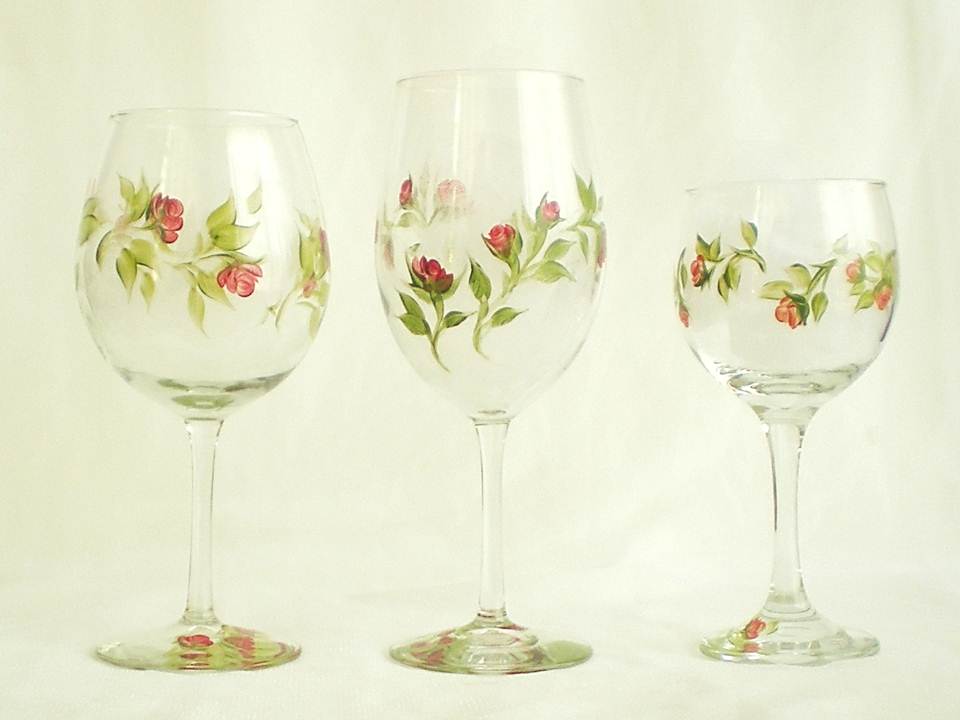
3 different shaped wine glasses

The stem may be long, short or nonexistent.   The stem allows the drinker to hold the glass without touching the bowl.  Touching the bowl raises the temperature of the wine; the temperature of the wine is important because low temperatures reduce the intensity, whereas high temperatures promote mainly alcoholic fumes.  

The stem also enhances the overall aesthetics of the glass.  Crystal stems are typically thinner and more elegant than glass stems.  Stemless glasses are fairly popular and provide a modern look although many modern wine glass designs feature stems.


The base or foot obviously holds everything upright.  One way my glasses are distinctive is that I paint a different design on each glass’ base, for distinguishing whose glass is whose.  Frequently, these designs also become a friendly conversation starter.
For more details on selecting the perfect wine glass, 
I find that Riedel has the most information at

One interesting aspect of the shape is that wide, open glasses require us to sip by lowering our head.  On the other hand, a narrow glass forces the head to tilt backwards to drink, and the wine flows because of gravity.  Thus, the wine is delivered and positioned for optimal placement on the different "taste zones" of the palate.

As with choosing wine, there is some flexibility in glass selection.  Nonetheless, using the “wrong” glass obviously affects how we perceive the wine. Perhaps the drinker feels disappointed that the sweet fruit flavors are absent or that the flavor is overwhelmed by tartness.  When this happens, the wine is thought to be the culprit rather than the shape of the glass.
It will take time to recognize that
a glass is not just a glass, 
but an instrument of 
pleasure and enjoyment. -- Riedel

At your next party, you'll be the expert on wine glasses!  Cheers!

Sheryl

Wine Glasses - Black and Silver

Joseph's Coat Glasses

Beverage glasses - Joseph's Coat design

Thursday, August 4, 2011

Keeping the “U” in Customer Service

Actually, it’s not the “U,” it’s the “You.” 

Below, I’ll tell you why it’s extra-important to stress your focus on your customers, and how to modify your writing style to do so.  Future posts will share writing tips so you can anticipate and address some common customer service issues, allow you to remain firm in your policies – and maintain your customer-centered style.

Selling online presents challenges that brick-and-mortar stores don’t face.   For example, our customers can’t touch or closely examine our wares, or return an item on their way to the grocery store, or rely on our community presence for assurance of our integrity. 

We also don’t have the luxury of a live conversation to clarify our return policy or clothing sizes.  Instead, we must provide detailed information, anticipate as many customer questions and issues possible, and lay out our policies concisely and accurately, all the while establishing our friendliness and credibility using the written word.

Part of the success in conquering these challenges lies (1) in establishing the right tone, (2) informing clearly and concisely, and (3) communicating directly without sounding unfriendly or difficult to buy from.

In this post, let’s tackle the first item -- setting up the right tone.  This would be like opening wide the door in your B&M boutique with a big smile, and drawing in your customer with a friendly welcome.  She is confident that you are devoting your attention to her desires and needs.  You communicate parameters about sizes and pricing while maintaining relaxed eye contact with her, and she stays engaged to listen to what you are saying.

Similarly, in your online shop, when you write with a “you”-centered style, you convey information and assure her that you care about her satisfaction – and keep her engaged by focusing your writing on her. 

The most effective way to do so is to put the U back in "customer."  Instead of using the pronoun “I” several times in your sections, use “you”.  The effect is to move the emphasis to your customer – who wants to feel important to you, the seller.

Suppose I write “I want all happy customers,” who is the person emphasized:  me or the customer?  To me, this appears to say that I and my ‘wants’ are more important than the customer.  However, if I write, “Your delight and satisfaction in your purchase are my main concern,” how does that change the tone of the conversation?

Here’s another example:
. . . I love to sew and use lots of color.  I make a wide variety of things.  I like to make things that I think people will want to buy because my friends told me I should sell my items.. . .

In the example above, “I” or “my” is used 7 times:  who is the emphasis on?  Also, would you say seven I’s verbally to engage a customer entering your B&M boutique?

Compare it to this:
 . . . You’ll see many colorful handmade items here at HandmadeColors, which I create with your tastes and style in mind. . . .”

In the example above, “you” is used at the beginning to draw in the customer and to involve her in your “conversation.”


These are obviously fictitious examples and everyone’s situation and specific style are unique.  Yet, I do believe your sales will improve by setting the tone – the voice -- for ensuring a welcoming and engaging visit for your customer. I invite you to try it; please let me know how it goes!

If you want your customer to know she is important to you,
convey it to her by putting the “U” back in customer service!
You will be glad you did!

In a future post, I’ll discuss how you can tackle the second step – informing clearly and concisely – to make your shop customer-centered and effective. 

Friday, April 15, 2011

I guess that God had something He wants me to think about today.

It all started with Donna and John's Peace Dove, from Laughing Fridge (they make very cool  'frig magnets). 

http://www.etsy.com/listing/68484781/fridge-magnet-peace-dove-bird-blue?ref=tre-4da8ccf912d26d911fbc90fb-1

I have one on  my 'frig.  Each time I pass the 'frig, I think about the Peace Dove and the legend behind it. But, it was still on my mind today as I started making a collection of things I love on Etsy, and the Peace Dove was the first item I chose.

Then the rest of the collection came behind it, echoing the feeling from the Peace Dove.

Shawna Erback's paintings really capture hopefulness and a sense of wonder. 
http://www.etsy.com/listing/62790369/art-print-by-erback-fantasy-surreal?ref=tre-4da8ccf912d26d911fbc90fb-5

I have enjoyed several epiphanies this week, one of which is that I can wear perfume again!  Ever since I was brain-dented in 2000, I haven't been able to wear perfume.  But, I discovered this week that now I can -- YAY -- as well as how much I missed it.  It's a little thing, perhaps, but I think little joys are hints of things for us to notice.

And, would that I always take the time to celebrate those joys.
http://www.etsy.com/listing/39521998/flying-away-2009-original-signed?ref=tre-4da8ccf912d26d911fbc90fb-3

My closing thought today is this:
In all that you do and in all that you aspire, do it with Grace and Peace.

Blessings to you.
Sheryl

Sunday, February 27, 2011

Do You Know What Works?

What works, works!

Remember the adage, “Do it right the first time”?  I do, too.
                                                                                    
But, doing something ‘right’ isn’t always the most effective way because the best and most effective way may be, simply, what works.  The “right” way may be more theoretical, expensive, complicated or take longer – and by the time you get done with all that, you’ve lost sight of what you wanted to accomplish in the first place.

In other words, what works, works!

An example of how I used this approach to help my Etsy shop is photos:  having the best possible photos for Hand Painted Petals is important to me.  And, taking terrific photos means planning, right?  And, so if you’re like me, you plan for a marathon session where the phone doesn’t ring, you don’t have a headache and, mostly, you’ve memorized hundreds of ideas for “taking great photos.”  Meanwhile, items pile up while awaiting great photos, not producing sales or income and mocking you at every sheepish glance.  When the pile begins to take over the living room, though, it’s time to reassess.

Instead of trying to take the very best photos known to humankind, what if you tried to take the best photos you can at this time, with the knowledge and materials you have and in a reasonable amount of time?  You can always go back and improve or correct them, correct? 

I believe that rethinking my “wait for the best” approach helped reduce my reluctance to take photos.  Ironically, giving myself permission to not produce the perfect photo has resulted in better photos because I’m more relaxed about the process.  I can better use the ideas I receive from my Etsy teams and from Handmadeology, Etsy and other sites when I’m not programmed for failure to produce the “right” photo.

Selling online is certainly a challenge.  We must indulge our creative side, yet manage our time vigilantly.  My frustration level really peaks (my husband might say “uncorked” is more accurate) when I have to redo something:  it’s moving my business backward! 

I find my frustration level is related to my procrastination level:  the longer I put things off while “planning” and “researching”, the more frustrated I get by not making forward progress in my shop.  When I’m frustrated, I can’t be creative and somehow the paintbrushes know when I’m frustrated.  Not that I’m paranoid, but they conspire against me.
 
It really makes more sense to focus on forward progress – doing what works.

Now, I could continue with additional examples and cite outside sources to create an impressive blog post.  Or, I could simply post as-is because . . . this simpler post will also work to get my point across to you.  And, you’ll be able to get back to your work, hopefully less frustrated and more fired up to
Do what works.

Yours in creating effectively,
Sheryl